How to repair squeaky brakes starts with working out what the noise actually is. Not every squeak means worn pads. Dust, moisture, glazing and worn hardware all cause noise too. A high squeal is usually a warning, a metallic grind means metal on metal, and a squeal with a changed pedal means stop driving.
Searching for how to repair squeaky brakes usually turns up a lot of confident advice about sprays and sanding. Some of it is fine. Some of it will quiet a noise that was telling you something useful. Before you silence anything, it is worth knowing what the noise actually is.
Common Reasons Brakes Squeak
These are the six causes we trace most often at our Flinders Park workshop.
Wear Indicators
Most pads carry a small metal tab that contacts the disc once the friction material gets low. That squeal is a scheduled reminder, not a defect.
Dust and Surface Rust
Cars parked outside overnight often squeal for the first few stops. Surface rust builds on the discs and scrubs off within about a minute or so.
Glazed Pads or Discs
Heavy or prolonged braking overheats the pad surface and glazes it to a hard shine. Glazed pad material grips less and squeals a good deal more.
Wrong Pad Material
Pad compounds are not interchangeable. Cheap, hard material fitted to the wrong vehicle can be noisy from day one and wear the discs out faster.
Worn Shims and Hardware
Anti-rattle shims, clips and slide pins keep the pad located. When they are missing, corroded or dry, the pad starts vibrating against the disc.
Something Caught
A stone lodged between disc and shield makes a sharp, constant scraping that changes with speed and often stops the moment you touch the brakes.
A squeal is information. Silencing it without knowing what caused it is how a cheap pad replacement becomes an expensive disc replacement.
DIY Inspection vs Professional Help
There is a sensible amount of checking an owner can do, and a clear line past which it stops being sensible. Most advice on how to repair squeaky brakes ignores that line entirely.
Reasonable to check yourself
- Look through the wheel. On many cars you can see the outer pad. If the material looks thinner than about a third of the backing plate, it is getting on.
- Check for debris. Have a look for a stone or grit caught around the disc or shield.
- Note when it happens. Only when cold, only under hard braking, or all the time. That pattern is genuinely useful to a mechanic.
- Check the brake fluid level. A dropping level usually means either wear or a leak, and both matter.
Leave to a workshop
- Removing wheels or calipers. Brakes are the system where a mistake has no second chance.
- Sanding or filing pads and discs. It can mask a symptom while removing material you needed.
- Spray-on silencers. Fine fitted correctly during a pad change. Sprayed at an assembled brake, they hide the warning.
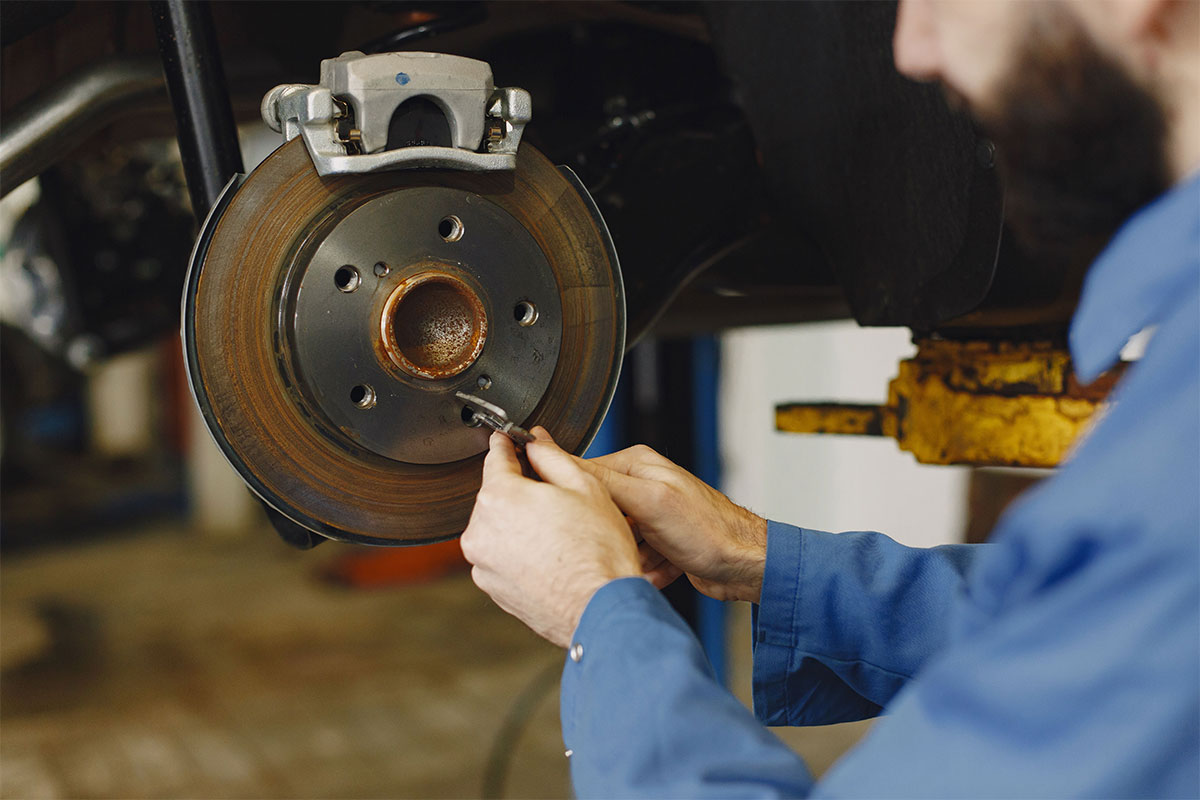
- Measuring wear properly. Pad and disc thickness are measured against specification, not judged by eye.
The Dangers of Ignoring Brake Noises
The reason brake noise is worth acting on quickly is that the cost curve is steep.
Pads that are simply worn are a routine replacement. Pads left until the friction material is gone put the backing plate against the disc, and that ruins the disc. What could have been a pad replacement becomes pads and discs. Left longer, heat and metal-on-metal contact can damage caliper components too.
There is a safety cost running alongside the financial one. Worn or glazed pads lengthen stopping distances. Uneven braking across an axle, often caused by a seized caliper on one side, pulls the car under braking. Neither behaves well in an emergency stop, which is exactly the moment you find out.
| What You Hear | What It Usually Means | What to Do |
|---|---|---|
| Squeal only when cold | Surface rust or overnight moisture. | Monitor. If it clears in a minute, likely nothing. |
| Consistent high squeal | Wear indicator, glazing or hardware. | Book an inspection soon. |
| Metallic grinding | Friction material gone, metal on metal. | Book now. Damage is accruing every trip. |
| Squeal plus vibration | Warped or unevenly worn discs. | Book an inspection. |
| Noise plus soft pedal | Possible fluid or hydraulic problem. | Stop driving it and call. |
When to Book a Brake Inspection
Book it in if any of these apply.
Book it in if
- The noise has lasted more than a few days and is not just a cold-morning squeal.
- You can hear grinding or scraping rather than squealing.
- The pedal feels soft, spongy, or travels further than it used to.
- The car pulls to one side when you brake.
- You feel vibration through the pedal or the steering wheel under braking.
- A brake warning light has come on, or the fluid level has dropped.
- You cannot remember the last time the brakes were properly inspected.
An inspection is quick and it settles the question. Our brake repairs page covers what we check and what the work involves, and brakes are inspected as standard during a car service too.
| Common Questions |
Frequently Asked Questions
Can I work out how to repair squeaky brakes myself?
You can safely identify the likely cause, check for debris and get a rough look at pad thickness. Actually carrying out the repair means removing wheels and calipers and measuring against specification, which is where it belongs in a workshop.
Is it safe to drive with squeaky brakes?
A brief cold-morning squeal that clears is usually fine. Persistent squealing means book an inspection. Grinding, a soft pedal or pulling to one side means stop driving and call.
Will new pads always stop the noise?
Not always. If the discs are scored or the hardware is worn, new pads on their own can still be noisy. That is why the whole system gets inspected rather than just the pads.
How long do brake pads last?
It varies enormously with driving style and conditions. Stop-start city driving wears pads far faster than highway running. Rather than guessing from kilometres, have them measured at each service.